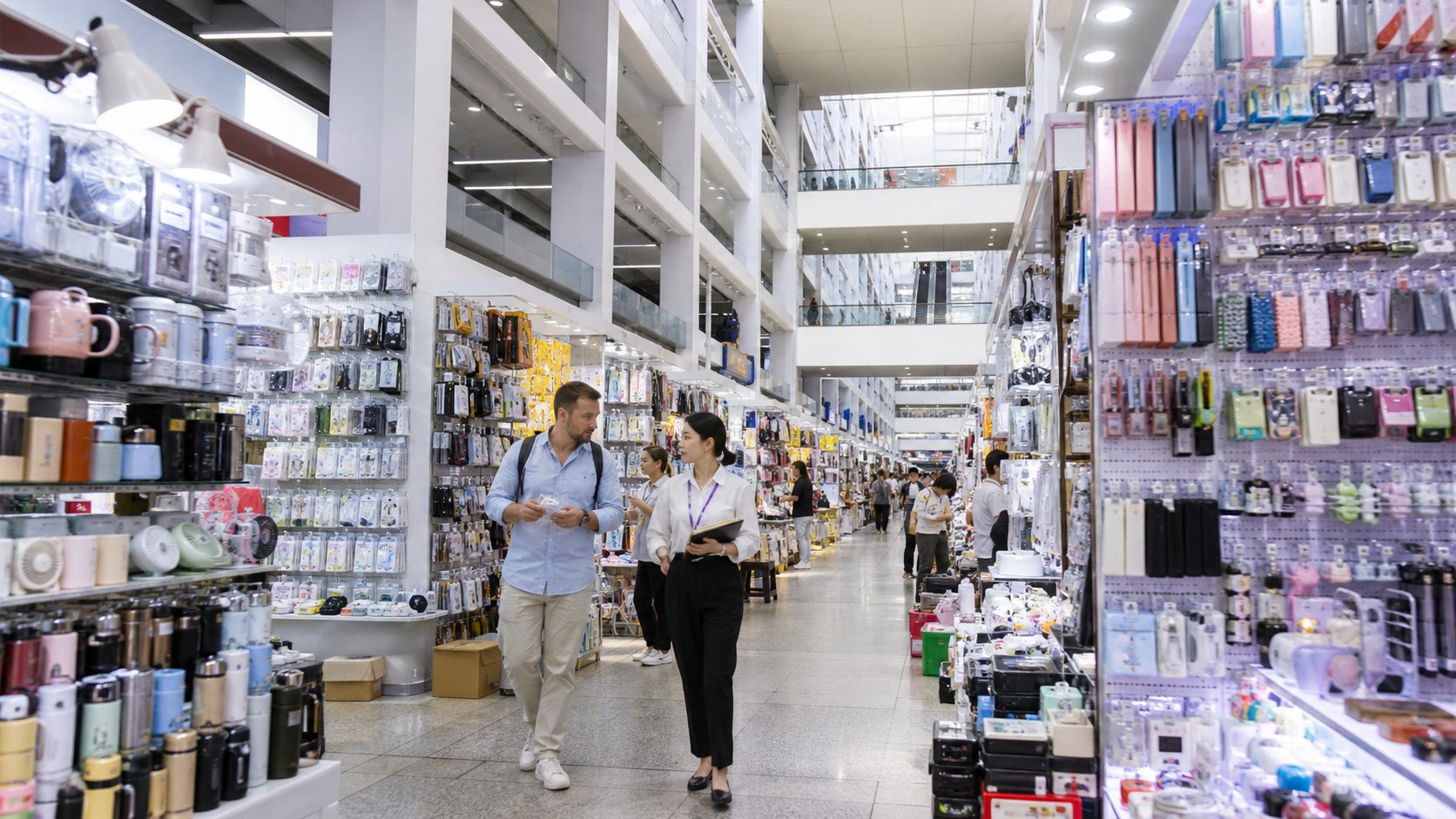
There are markets, and then there is Yiwu.
The Yiwu International Trade City in Zhejiang province is the largest wholesale market on earth: roughly 75,000 booths across five districts and several annexes, selling somewhere between 400,000 and 2 million product types (nobody has a precise count, including the people who run it). Foreign buyers place around half a million visits' worth of orders here every year. If a small commodity exists, it is sold in Yiwu — and the price you'll get there has a way of recalibrating what you thought things cost.
But first-time visitors routinely waste two or three days finding that out the hard way. The market is enormous, mostly analog, and completely in Chinese. This guide covers everything a first-time buyer needs: what Yiwu actually is, how the districts are organized, when to go, how much money to bring, how buying actually works booth by booth, how bargaining functions, how goods get from booth to your country, and the mistakes that cost newcomers the most.
This is the guide we hand our own clients before their first trip. (And if you'd rather not make the trip at all — that's what we're here for; see How a Yiwu Sourcing Agent Helps You Buy from the Yiwu Market.)
What Yiwu Actually Is
Yiwu is a county-level city about 1.5 hours south of Hangzhou by train. Three decades ago it was a small trading town famous for being scrappy; today it is the physical hub of the world's small-commodity trade — the place where shops, Amazon sellers, dollar stores, importers, and gift shops from 200+ countries come to buy.
Three things make Yiwu different from buying online:
- Everything in one place. Instead of comparing five Alibaba suppliers across a week of emails, you can see 200 booths selling the same category of product in one afternoon, comparing quality and price side by side, in person.
- Small mixed orders are the whole point. Yiwu was built for the buyer who wants 50 umbrellas, 200 phone cases, 30 picnic blankets, and a few hundred keychains — all in one container. Factories elsewhere impose MOQs measured in thousands; Yiwu booths sell by the carton.
- Prices are domestic-wholesale prices. Many booths are factory-direct or factory-adjacent, and the prices are set for Chinese domestic buyers — not the "foreigner price" you get quoted online.
The trade-off: Yiwu sells small commodities — items roughly under $20 retail. If you're sourcing machinery, electronics requiring certification, or high-spec custom manufacturing, Yiwu is the wrong venue (see our guides on manufacturing cities and industry clusters instead).
The Market Geography: Five Districts, One Map in Your Head
The main complex — International Trade City (国际商贸城, locally "Futian Market") — has five districts (districts 1 through 5, or "一区" to "五区") plus an annex (the Huangyuan Market for garments/night market adjacent goods). Each district specializes. Memorize this before you go; it will save you a full day of walking.
District 1 (一区) — Toys & Florals
The oldest and most famous district. Ground floor: stuffed toys, plastic and electronic toys. Upper floors: artificial flowers and plants, decorative items. Toys buyers should start here — but note that toy safety compliance is on you (see our toy certification guide).
District 2 (二区) — Umbrellas, Rain Gear, Hardware
Umbrellas and rain gear dominate one side of the ground floor — hundreds of booths. Hardware, tools, locks, electrical fittings, and luggage/wheeled bags fill the rest.
District 3 (三区) — Stationery, Office & Sports
Stationery, office supplies, school supplies, sporting goods, and outdoor gear. One of the most popular districts for general merchandise buyers and Amazon sellers.
District 4 (四区) — Socks, Daily Goods, Belts
Socks and hosiery (huge section), belts, towels, daily-use sundries. Great for mixed general-store containers.
District 5 (五区) — Import Goods & Specialty
Imports from other countries (Korean, Japanese, African, SE Asian goods), plus fabric accessories, automotive accessories, and a section for handicrafts.
Beyond the main complex
- Huangyuan Clothing Market — garments, fashion basics
- Zhaozhai / night market area — smaller, cheaper, more chaos
- Professional streets outside the complexes — e.g., a street of only button shops, a street of packaging suppliers
Practical tip: booths are numbered like a grid (district–street–booth). Photograph the booth number of anything you order — "that shop with the nice lady near the escalator" is not findable in a market this size. Your agent will do this automatically; solo buyers must do it themselves.
When to Go: The Calendar That Actually Matters
- Best months: March–June and September–early December. Mild weather, full market, normal logistics.
- Chinese New Year (late January–February): the entire market closes for roughly 2–4 weeks, and the whole country's supply chain scrambles for the two weeks before it. Do not plan a trip through CNY unless you enjoy closed shutters.
- October: overlaps the Canton Fair (Guangzhou, ~1hr flight away). Many buyers do both in one trip — Canton Fair for factories and big-ticket categories, Yiwu for small commodities. Convenient, but hotels in both cities get expensive and full; book early.
- Yiwu Mart (October): the city's own trade fair, held right next to the market complex.
- Christmas season logic: overseas buyers order Christmas stock from Yiwu in June–July to ship in time. Arrive in December looking for next year's Christmas goods and you'll find leftovers. (See Christmas Products Sourcing from Yiwu ← 内链子文章)
Preparing Your Trip: Visas, Flights, Hotels, Money
Visa: China's visa policy has loosened considerably — many European countries now enjoy visa-free entry for short business trips, and there's a 240-hour transit visa-free option. Check the current list for your nationality before applying; rules change often. If you do need a visa, an invitation letter from your agent or a hotel booking plus itinerary gets you a business (M) or tourist visa.
Getting there: Fly to Hangzhou Xiaoshan or Shanghai Pudong, then high-speed rail to Yiwu station (Hangzhou ~1hr, Shanghai ~1.5–2hrs). From Yiwu station, taxi to the market area is 20–30 minutes. There are also direct flights to Yiwu airport from some Chinese cities and a handful of international destinations (mostly SE Asia).
Where to stay: Around the Futian market district — dozens of hotels from $30 to $150/night within walking distance of the main complex. During Canton Fair overlap, prices roughly double; book a month ahead.
Money:
- Bring some cash (RMB) for small purchases and taxis.
- UnionPay and increasingly Visa/Mastercard work at hotels and bigger stores; market booths mostly use WeChat Pay/Alipay. Set up Alipay or WeChat Pay with your international card before arrival — this is the single most useful prep item. Both now accept foreign cards with reasonable fees.
- Most booths will also accept USD cash informally at poor rates; don't.
What to bring:
- Your business cards (booths still trade on them)
- A power bank, comfortable shoes (you'll walk 15–20k steps/day)
- Reference photos or samples of products you want, printed or on your phone
- A luggage scale if you plan to carry samples home
How Buying Actually Works, Booth by Booth
This is the part first-timers get wrong: you almost never buy on the spot. The standard flow:
- Browse and compare. Look at quality, ask "how much" (多钱?), photograph the product and the booth number.
- Ask the key questions: price per carton, carton quantity (箱规 — how many units per carton), minimum order (usually 1–5 cartons per SKU at Yiwu), whether customization (logo, color, packaging) is possible, and lead time.
- Collect quotes across many booths — for any popular category, get 5–10 quotes before deciding. Prices for the same item can vary 30%+ between booths.
- Place the order through an agent or consolidator. The booth issues a sales slip (出库单/订货单); goods are delivered to your agent's warehouse — usually after 2–7 days, as most booths restock from factories.
- Consolidate, inspect, pack, ship. Your agent gathers everything from dozens of booths, inspects, repacks into export cartons, and loads your sea or air shipment.
Solo buyers can do steps 1–4 alone using translation apps, but you'll still need a consolidator/export agent for step 5 — booths do not handle export. This is why virtually every serious Yiwu buyer works with a local agent who handles ordering, payment, consolidation, and export in one workflow. (More in Yiwu Purchasing Agents: How the Agent Model Works in the Market ← 内链子文章)
Payment: booths expect ~30% deposit at order, balance before delivery from factory. If you're working through an agent, you typically pay the agent (who pays booths) — one transfer instead of forty.
Bargaining: The Real Rules
Yiwu prices are quoted with margin for negotiation, but less theatrically than you might fear. What actually works:
- Ask for the tier price: "How much for 5 cartons? 20 cartons? A full pallet?" Volume discounts are real and instant.
- Compare visibly: telling a booth you have a quote of ¥3.2 for the identical item down the street (ideally true) moves numbers fast.
- Bundle within a booth: more SKUs at one booth = better overall pricing.
- Don't grind to the last fen: the relationship you build determines how problems (late delivery, quality slips) get treated later. Getting an extra 2% while making the booth owner resent you is a bad trade.
- Walk away once: if the price genuinely doesn't work, politely leave. Many booths make a final offer as you go.
What doesn't work: aggressive haggling over small orders, asking for factory pricing on one carton, or the "50% opening offer" routine — Yiwu quotes are already wholesale; the negotiating band is usually 5–20%.
Full negotiation playbook: How to Bargain in Yiwu Market: Negotiation Tips from Local Agents
Budgeting: What a Trip Actually Costs
Sample budget for a 5-day buying trip (one person, from Europe/US):
| Item | Estimate |
|---|---|
| Flights (return) | $600–1,400 |
| Hotel (5 nights) | $200–500 |
| Food & local transport | $100–200 |
| Visa (if needed) | $30–140 |
| Trip total | ~$1,000–2,200 |
That's the cheap part. The real economics: goods + consolidation + freight. A mixed 20ft container of Yiwu goods might run $15,000–40,000 in product (enormous variety — hundreds of SKUs), plus consolidation and export handling ($500–1,500 depending on agent and complexity), plus sea freight (varies wildly by destination and season — get a current quote, don't trust blog numbers including this one).
Key budget insight for first-timers: freight is often the biggest line item on a mixed Yiwu container. Buying lighter, denser products (and skipping bulky-but-cheap items like plastic tubs) can cut shipping cost dramatically. We watch container-fill efficiency on every mixed order — see How to Ship a Container of Mixed Goods from Yiwu.
Small Orders and the MOQ Question
The #1 question we get: "Can I buy below MOQ?" At Yiwu: mostly yes. Booths sell by the carton, and many will sell a single carton of a SKU (10–100 units depending on product). Mixing 50 SKUs into a small consolidated air shipment is a completely normal way to test the market before committing to container volumes.
The trade-offs of small orders: unit prices are higher (you're not getting the 20-carton tier), air freight costs more per kilo, and some services (custom packaging, logo printing) only kick in above certain volumes. Details and workarounds: Can You Buy Small Quantities (Below MOQ) in Yiwu? Yes — Here's How
The Mistakes That Cost First-Timers the Most
- Buying on day one. Prices only make sense after comparison. Newcomers order excitedly on the first morning, then discover the same item 25% cheaper two rows over.
- Not recording booth numbers. "That shop with the nice lady" cannot be re-ordered from. Photograph the booth number with every product you're serious about.
- Ignoring the weight/bulk of purchases. Freight is charged by volume or weight, whichever costs more. Bulky cheap goods can cost more to ship than to buy.
- Skipping inspection. Booths will happily ship your order assembled by whoever restocks them that week. A pre-shipment check at your consolidator's warehouse catches the wrong quantities and broken items while fixing them is still free.
- Underestimating paperwork and certifications. If you're reselling in the EU/US, children's products, electronics, cosmetics, and food-contact items carry certification requirements the booth knows nothing about and will not warn you about. Compliance is the buyer's job.
- No plan for the money. Decide your budget per category before you arrive; the market is expert at making money evaporate into "just one more carton" purchases.
- Going during Chinese New Year. Still worth repeating.
One-Day Sample Itinerary
For buyers with limited time (full version: One Day in Yiwu: Sample Sourcing Itinerary for First-Time Buyers):
- 8:30 — Arrive at the district matching your #1 product category (check the district map above). Markets open ~9:00; booths at 8:30 are being restocked, useful for seeing carton markings.
- 9:00–12:00 — Systematic walkthrough of your category: photograph products + booth numbers, collect 10+ quotes. No ordering.
- 12:00–13:00 — Lunch in the market complex (plenty of options; follow where booth owners eat).
- 13:00–16:00 — Second pass: revisit the 3–5 best booths, negotiate, place orders (or hand your agent the shortlist for final negotiation).
- 16:00–17:00 — Meet your agent/consolidator: review the day's orders, payment plan, delivery schedule.
- Evening — Organize photos and quotes; some buyers revisit Huangyuan or the night market area for fashion categories.
Yiwu or Not? Quick Comparison
- Yiwu vs Guangzhou: Yiwu wins on variety-per-day and mixed small orders; Guangzhou wins for fashion garments, shoes, and beauty supply at better depth. (See Yiwu vs Guangzhou Wholesale Markets ← 内链子文章)
- Yiwu vs Alibaba/1688: Yiwu gives you touch-the-goods certainty and small mixed orders; 1688 gives you breadth without travel but with verification risk. Many buyers use both: find in Yiwu, reorder via the booth's 1688 presence.
- Yiwu vs Canton Fair: the Fair shows factory capabilities and new products on a schedule; Yiwu runs 365 days and is better for immediate mixed buying. October buyers often do both.
Frequently Asked Questions
Do I need to speak Chinese? No — but you need either a translation app, an agent, or both. Booth owners deal with foreign buyers daily; pointing, calculator, and WeChat bridge most gaps. For real negotiation and custom orders, an agent earns their fee fast.
Is Yiwu only for huge orders? No — that's its main advantage. Carton-level buying and consolidated small shipments are standard practice.
Are Yiwu prices really the lowest? For small commodities at wholesale volume, Yiwu is very close to the floor — booths compete in a 75,000-booth market. But quality tiers vary enormously; the cheapest quote is usually the cheapest product. You're choosing a price-quality point, not hunting a mythical "real price."
Can I get custom logo/packaging at Yiwu? Yes, for most products — booths route customization to factories. Expect modest MOQs for printing (often a few hundred to a few thousand units depending on process) and a few extra days of lead time.
Is it safe? Yiwu is one of the safest cities you'll ever visit, with a large resident foreign-buyer population. The risks here are commercial (bad quality, wrong quantities, overpaying), not physical.
The Bottom Line
Yiwu rewards preparation and punishes improvisation. Know your districts before you land, compare before you buy, record every booth number, mind the freight math, and put compliance on your own checklist. Do that, and the market is genuinely one of the most powerful buying environments in the world — a place where a two-person e-commerce business can assemble a container of 200 different products in three days.
And if a five-day trip to navigate a 75,000-booth market in Chinese isn't your idea of fun — that's literally our job description. Get in touch to plan your Yiwu buying →
More Yiwu Guides
- How a Yiwu Sourcing Agent Helps You Buy from the Yiwu Market
- Yiwu Market District Map: Which District Sells What
- How to Bargain in Yiwu Market: Negotiation Tips from Local Agents
- Can You Buy Small Quantities (Below MOQ) in Yiwu?
- How to Ship a Container of Mixed Goods from Yiwu
- Yiwu vs Guangzhou Wholesale Markets
- Christmas Products Sourcing from Yiwu
- Yiwu Market Scams to Avoid
- One Day in Yiwu: Sample Sourcing Itinerary
- Yiwu Purchasing Agents: How the Agent Model Works