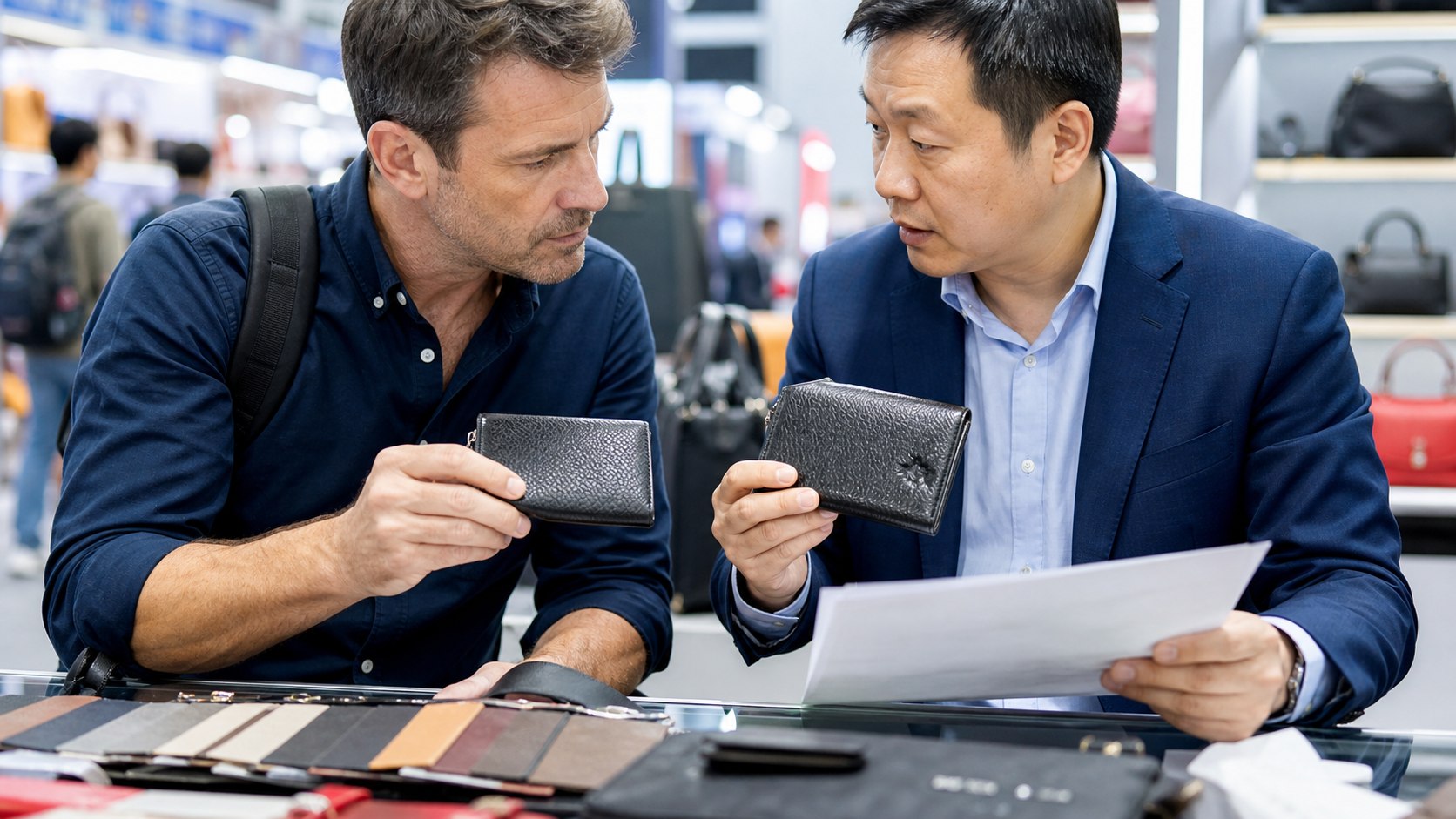
Let's start with perspective: Yiwu is a professional, functioning market where the overwhelming majority of transactions go fine. It's also a market of 75,000 booths with no entry exam, selling largely unbranded goods to foreign buyers who can't read the price tags. That combination attracts a predictable set of tricks.
None of these nine are exotic. All of them are avoidable with the same handful of habits. We've watched every one of them happen — mostly to buyers who were in a hurry.
1. The "Factory-Direct" Booth That Isn't
The claim: "we are factory, best price." The reality: a booth buying from the same wholesalers you could theoretically reach, adding a margin. It's not illegal and often not even harmful — but the "factory price" story collapses the moment you ask for customization the booth can't actually control, or production timelines the booth can't meet.
Defense: for stock goods, it doesn't matter much (judge the price and quality on their merits). For custom production, ask for the factory name/address and expect to deal through an agent who can verify it.
2. Quality Switch Between Sample and Bulk
You approve a sample from Grade-A stock; the bulk order ships with Grade-B "seconds" — slightly off-color, minor defects, mixed production runs. The booth's answer when caught: "different batch, same thing."
Defense: keep the approved sample with your consolidator as the golden sample; make bulk acceptance conditional on matching it. This is standard practice for a reason — see our QC guide. On mixed-market goods, even a simple side-by-side photo comparison at the warehouse catches most switches.
3. The Deposit Trap
A booth demands 100% payment at order (not the normal ~30% deposit) and then becomes slow, evasive, or creatively unavailable. The deposit wasn't for goods; it was the goods.
Defense: never pay booths 100% upfront. Pay deposits through your agent, whose balance payment is the leverage that gets problems fixed. If you're solo, keep the deposit at 30% and the balance strictly against delivery to your warehouse.
4. The Price That Rises After You Commit
Quote: ¥3.4/unit. After you've paid the deposit: "material price went up, now ¥4.1." Works best on buyers who've already arranged everything downstream around the original price and feel forced to absorb it.
Defense: get the price, spec, MOQ, and deposit terms on the order slip in writing; a written quote makes the renegotiation play much harder. And never pay a deposit on a verbal price.
5. The Disappearing Quantity
Order 100 cartons; 93 arrive. If nobody counts at the warehouse, the booth keeps the difference, and you discover it at your destination warehouse on another continent — unprovable and unrecoverable.
Defense: arrival quantity check against the slip, at consolidation, before the balance is paid. This is a 5-minute job that a warehouse does automatically — and it's the reason consolidators exist.
6. The "Helpful Translator" with a Hidden Margin
A friendly freelance translator/guide at the market helps you buy — and collects 5–10% from the booths afterward, quietly built into your prices. You pay for the help twice: once in goodwill, once in margin, and the "help" steers you toward the best-paying booths, not the best ones.
Defense: if you hire help, hire it transparently — agree on a fee paid by you, and ask directly whether they take booth commissions. An honest answer is fine either way; a flustered one is your answer too.
7. Copy Products Sold as Certified
Toys, electronics, cosmetics at the market carrying certification-looking marks (CE, FCC) that are, at best, decorative. The booth genuinely may not know or care — but when your customs authority or marketplace platform asks you for the compliance file, decorative marks won't help.
Defense: compliance is the importer's legal responsibility, full stop. For regulated categories (children's products, electronics, food-contact, cosmetics), either source through a channel that can produce real test reports or budget for your own testing. See our certifications guides.
8. The Fake "Market Official" / Overcharging Middleman
Someone at the market complex offers to "handle everything" — buying, export, shipping — at prices that sound easy but bundle 20–30% hidden margin, or worse, collect money and subcontract to whoever's cheapest with no accountability.
Defense: check the basics — business license, a real warehouse you can visit or video-verify, itemized invoices. The vetting checklist in How to Choose a Reliable China Sourcing Agent applies doubly at the market, where the barrier to claiming "agent" status is zero.
9. The Counterfeit Brand Goods Pitch
A booth quietly offers "same quality, no brand cost" versions of well-known branded products. This isn't a gray area: importing counterfeits exposes you to seizure, destruction, fines, and marketplace bans. Legitimate look-alike (generic) designs are normal at the market; counterfeit logos are radioactive.
Defense: just don't. The savings never survive contact with customs. If a design resembles a famous product, get your agent's opinion on whether it crosses into protected trade dress before ordering.
The Pattern (Again): Verification Beats Cleverness
Every scam above exploits the same gaps: no written record, no independent check, full payment upfront, or compliance ignorance. The defense is equally unglamorous:
- Written order slips with prices and specs
- Deposits through a party with leverage (your agent)
- Quantity and quality checks at consolidation, before final payment
- Golden samples kept on the ground
- Compliance treated as your problem, because legally it is
Do these five things and Yiwu's actual risk profile — for a prepared buyer — is genuinely low. The market's real dangers are commercial carelessness far more than cartoon villains.
For scams beyond the market (fake suppliers, payment fraud, company impersonation), see 10 Most Common China Sourcing Scams and Red Flags When Hiring a Sourcing Agent.
Buying in Yiwu soon? Have us review your plan before you pay anyone →