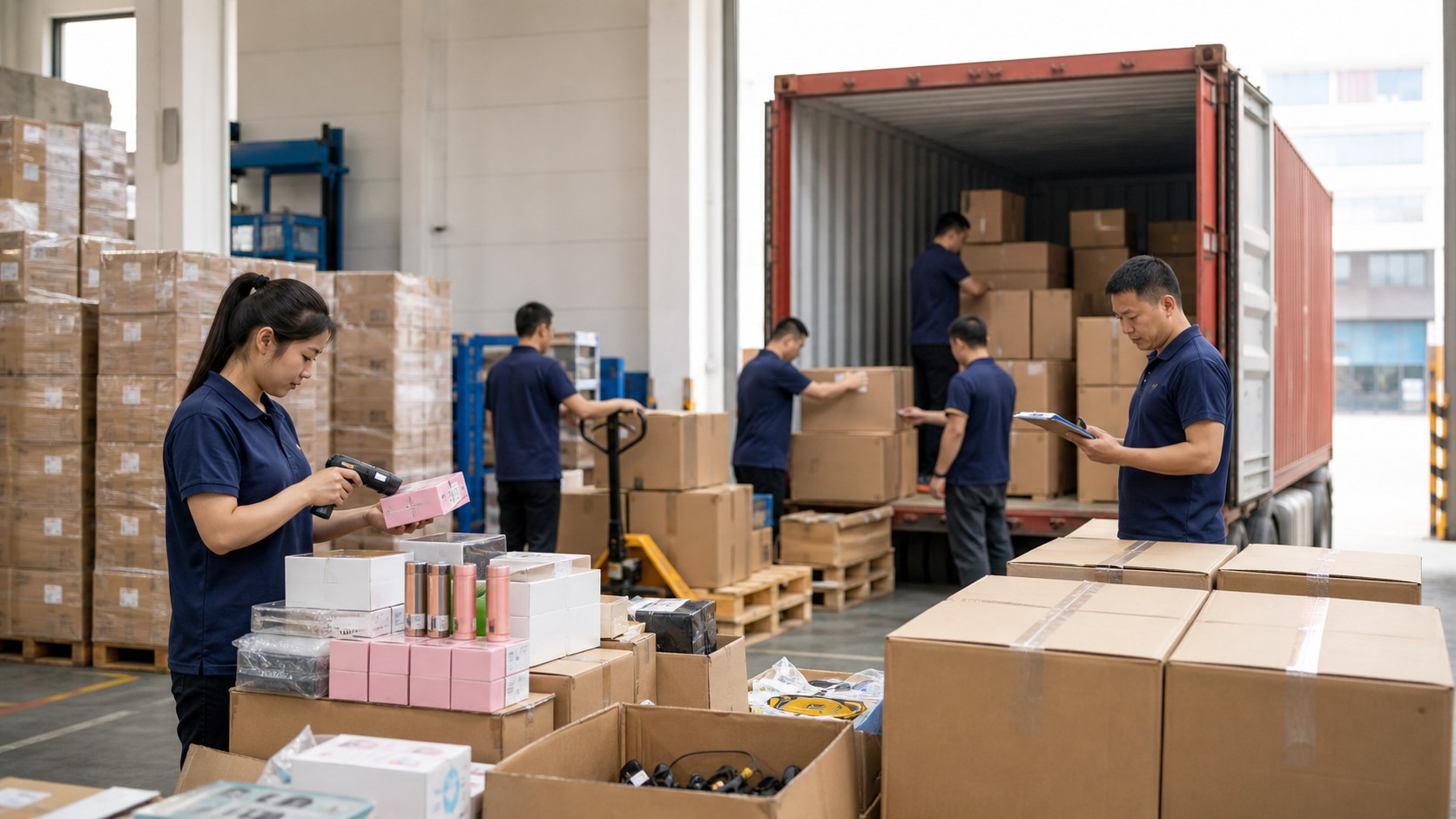
A container of goods from one factory is straightforward: the factory loads it, seals it, ships it.
A container of goods from 47 booths is a different animal. It has to be collected, checked, stored, repacked, sequenced, and loaded by someone who knows what they're doing — and the difference between a well-planned and a badly-planned mixed container is regularly thousands of dollars and weeks of delay.
Here's how the process works end to end, and where the money hides.
Step 0: Decide Your Target Volume Before You Buy
The single most common mistake: buying first, thinking about shipping later. Freight math should shape your purchasing:
| Shipment size | Method | When it makes sense |
|---|---|---|
| Under ~2 CBM | Air / express | Samples, test batches |
| 2–15 CBM | LCL (Less than Container Load) | Your goods share a container with others |
| 15+ CBM | 20ft FCL (≈28–30 CBM usable) | A full container of your own |
| 55+ CBM | 40ft / 40ft HQ (≈58–68 CBM usable) | Bigger volume, better per-CBM economics |
CBM (cubic meter) is the unit that decides everything. A carton of plush toys might be worth $60 and take up 0.15 CBM; a carton of phone cases might be worth $400 in the same 0.15 CBM. At $150/CBM sea freight, the plush toys' shipping cost per dollar of goods is 6x higher. Dense, valuable goods travel cheap; light, bulky goods travel expensive.
Practical planning rule: as you buy, track your running CBM estimate (carton dims × quantity). Stop adding bulky items once you approach your container target — or switch to a bigger box.
Step 1: Collection at the Consolidation Warehouse
Orders placed across booths arrive at your agent's warehouse over 2–10 days. Each arrival is checked against the order slip — SKU, spec, quantity. Discrepancies (short, wrong, damaged) are caught here, while the booth still owes a fix.
This is why consolidation reports matter: a professional agent gives you a live SKU-level status — ordered / arrived / checked / packed — not "everything's fine, don't worry."
Step 2: Inspection and Repacking
Mixed market goods come packed for domestic distribution, not export. Standard handling:
- Visual + functional spot-check per SKU (full AQL applies if you specify it)
- Repacking into export cartons — 5-layer corrugated, proper carton size to minimize void space
- Carton marking: shipping marks, SKU/carton number ("CTN 12/47"), gross weight, dims
- Final measurement: total CBM, total gross weight, carton manifest — the numbers that drive your freight quote and customs paperwork
Step 3: Choose Freight — and Understand What You're Paying For
Sea FCL (full container): cheapest per CBM at volume. Your container goes Yiwu → Ningbo or Shanghai port (both within trucking distance) → destination. Includes origin trucking, THC (terminal handling), ocean freight, destination charges.
Sea LCL (shared container): for smaller volumes. Priced per CBM with a minimum. Warning: destination LCL charges (devanning, warehouse handling) are per-CBM too and can be brutal — always ask your forwarder for door-delivery, all-in pricing, not just ocean freight, when comparing.
Air freight: per kg chargeable weight (actual vs volumetric — see our freight math guide). For small, light, high-value, or urgent orders only.
China-Europe rail: a middle option for Europe-bound cargo — faster than sea, cheaper than air, with its own schedule quirks.
Step 4: The Loading Plan
Loading a mixed container is a physics and Tetris problem:
- Heavy and dense at the bottom, at the front (over the axles)
- Light and bulky on top — but not stacked beyond carton crush limits
- Fragile items away from doors and walls, braced
- Fill the container tight — load shift in transit is the #1 cause of damage; voids get filled with dunnage or airbags
- Photograph everything — empty container, half-loaded, sealed with seal number visible. If damage happens in transit, these photos are your insurance claim.
A 20ft container theoretically holds ~28 CBM; realistically, mixed goods with imperfect cartons load to 25–27 CBM. Expecting 30 means a shortfall you'll discover at the port.
Step 5: Export Clearance and Documents
Your consolidator (under their export license) handles China customs export declaration. You receive:
- Commercial invoice (values for customs at destination — accurate values, always; undervaluing is fraud that catches up with importers at the worst time)
- Packing list (carton-by-carton manifest)
- Bill of lading (or air waybill)
- Certificates if applicable ( fumigation for wooden packaging, CO/FORM A if your destination offers tariff preferences — see our import tax guides)
Where the Money Hides: Cost Control Checklist
- CBM inflation from bad cartons — loose, oversized, half-empty cartons can add 15–20% to your effective freight bill. Repacking pays for itself.
- LCL destination fees — the classic ambush. Get all-in door quotes.
- Demurrage/detention — if your container arrives and you're not ready to receive it, ports and lines charge by the day. Have your customs broker and delivery booked before the ship docks.
- Peak season (Aug–Oct) — pre-Christmas space crunch raises rates and squeezes schedules. Order earlier; see our peak season guide.
- Insurance — ~0.3% of cargo value for all-risk marine cover. The cheapest line item on the whole shipment and the one buyers skip most often.
A Realistic Timeline
| Stage | Typical duration |
|---|---|
| Booth orders delivered to warehouse | 2–10 days |
| Inspection + repacking | 2–5 days |
| Trucking to port + export clearance | 2–4 days |
| Ocean transit | 15–35 days (destination-dependent) |
| Destination clearance + delivery | 3–10 days |
Plan 5–8 weeks door-to-door for sea freight, and add buffer around Chinese New Year and Q4.
Bottom Line
A mixed container is the highest-ROI shipment format Yiwu offers — hundreds of SKUs, one container, one set of fixed costs. But its economics are decided in the details: CBM discipline while buying, proper repacking, a real loading plan, and all-in freight quotes. Get those four right and the rest is logistics; get them wrong and the freight line eats your margin.
Send us your product list — we'll plan the container math with you →