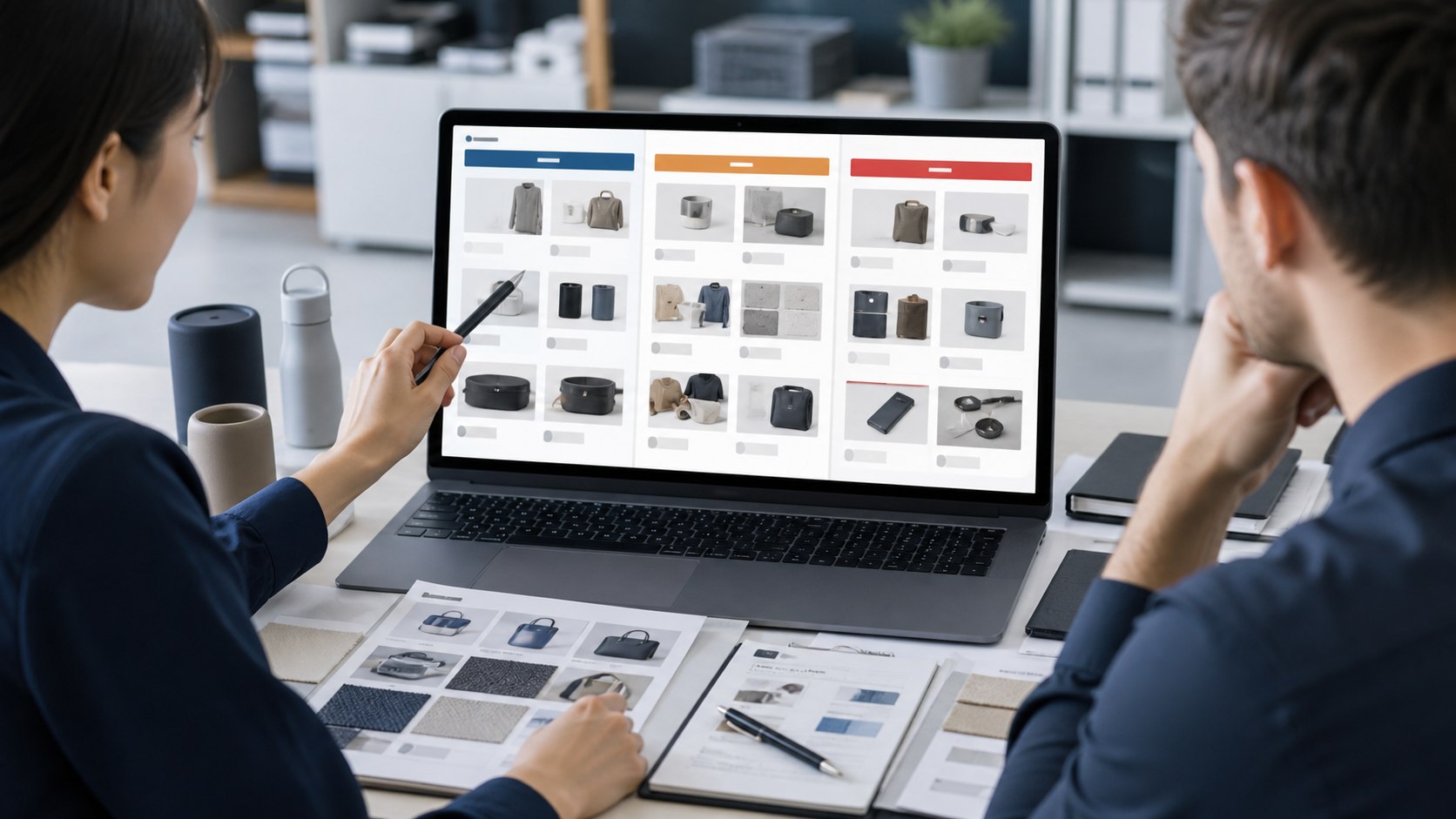
Ask ten importers where they buy in China and you'll hear the same three names. What you'll rarely hear is why — most buyers use whichever platform they found first and assume the others are interchangeable.
They're not. Alibaba, 1688, and Made-in-China serve different buyers, different order sizes, and different risk tolerances. Choosing the wrong one costs you either money (overpaying), time (fighting the language barrier), or both. Here's the honest comparison.
The 30-Second Version
- Alibaba — international-facing, English-friendly, buyer protection, higher prices. Best for: first-time importers, custom/OEM products, buyers who want hand-holding.
- 1688 — domestic Chinese wholesale, vastly cheaper, no English, minimal protection. Best for: cost-focused buyers with an agent or Chinese skills, stock (non-custom) goods.
- Made-in-China — mid-sized international platform, stronger in machinery and industrial categories. Best for: equipment, industrial goods, and finding factories that don't market heavily on Alibaba.
Now the details.
Alibaba: The International Default
What it is: the world's largest B2B marketplace, built for foreign buyers. English UI (plus other languages), trade assurance, verified supplier badges, RFQ system, logistics services.
Strengths:
- Accessibility. Everything works in your language, payments are familiar, and suppliers employ English-speaking sales staff.
- Trade Assurance. Orders placed through it have escrow-style protection: money back if goods don't match agreed specs or aren't shipped on time. It's not bulletproof (disputes hinge on documented specs), but it's real.
- OEM/ODM muscle. For custom manufacturing, Alibaba's supplier base is deep — molding, customization, packaging, samples.
- Verification layers. Verified Supplier audits, years-in-business data, transaction histories — imperfect signals, but far more than 1688 shows.
Weaknesses:
- Price. You're paying the "export price": supplier margins padded for international service, English sales staff, compliance paperwork — often 10–30% (sometimes more) above 1688 equivalents for identical stock goods.
- Trader density. A large share of "manufacturers" are trading companies. Not necessarily bad — but you should know which you're talking to. (See How to Verify a Supplier on Alibaba ← 内链)
- Competitive noise. Popular products get quote-bombed by hundreds of buyers; differentiation matters more than price alone.
Best for: first orders, custom products, buyers who value protection and communication over lowest price.
1688: Where the Real Wholesale Prices Live
What it is: Alibaba Group's domestic Chinese platform — effectively the online version of China's wholesale markets. Same companies you find in Yiwu and Guangzhou markets sell here at domestic prices.
Strengths:
- Price. The headline advantage: identical stock goods routinely 15–40% below Alibaba export quotes. This is not a trick; it's the domestic market's actual pricing.
- Breadth. If a product exists in Chinese wholesale, it's on 1688 — including items never listed internationally.
- Speed. Stock goods ship immediately from supplier warehouses; no 30-day production cycle for standard items.
- Live market intel. 1688 pricing tells you what things actually cost — the benchmark we use to sanity-check any quote, ours included.
Weaknesses:
- No English. Interface, listings, and supplier communication are all Chinese. Machine translation gets you surprisingly far for browsing, but negotiating specs and resolving disputes is another story.
- Payment. International cards generally don't work; purchases need Alipay with Chinese banking setup or an agent's account.
- No meaningful buyer protection. Disputes are resolved in Chinese, by the platform's domestic logic, and mostly in favor of whoever documents better — in Chinese.
- Stock-oriented. Customization exists but is clunkier; deep OEM work flows better through Alibaba or direct factory contact.
- Quality variance. Same as any wholesale market: multiple quality tiers of the "same" product, and the cheapest listing is the cheapest product.
Best for: stock goods buyers working through an agent (who handles language, payment, and inspection), and anyone wanting the true price benchmark. Full workflow: How to Buy from 1688 Without Speaking Chinese.
Made-in-China: The Industrial Specialist
What it is: a mid-sized international platform (China's #2 by international traffic), with a reputation skewed toward machinery, industrial equipment, raw materials, and mid-sized factories.
Strengths:
- Machinery and equipment depth. For CNC machines, packaging lines, food processing equipment, generators — categories where Alibaba feels consumerish — Made-in-China's supplier base is often stronger and more factory-direct.
- Less quote-bombing. Suppliers receive fewer inquiries than on Alibaba, so responses can be more attentive and pricing less "inflated for negotiation theater."
- Audited suppliers. Its verification program (similar to Alibaba's) adds a layer of diligence for big-ticket purchases.
Weaknesses:
- Smaller catalog for consumer goods categories.
- Same trader/factory ambiguity as Alibaba — verification is still on you.
- Less buyer-tooling than Alibaba (fewer integrated logistics/financing services).
Best for: industrial buyers, machinery, and as a second source when Alibaba quotes on equipment feel padded.
Head-to-Head Summary
| Alibaba | 1688 | Made-in-China | |
|---|---|---|---|
| Language | English + others | Chinese only | English + others |
| Typical price level (same stock item) | Highest | Lowest | Mid |
| Buyer protection | Trade Assurance | Minimal | Moderate |
| Best at | Custom/OEM, first-timers | Stock goods, price | Machinery, industrial |
| MOQ | Negotiable, export-scale | Often lower, carton-scale | Varies, industrial-scale |
| Payment for foreigners | Easy (cards, TA escrow) | Hard without agent | Moderate |
| Supplier mix | Heavy trader presence | Factory+wholesaler mix | More factory-direct |
The Strategy Most Experienced Buyers Actually Use
The platforms aren't rivals; they're stages of a process:
- Discover on Alibaba — communicate in English, qualify suppliers, get samples of custom products, use Trade Assurance for first orders.
- Benchmark on 1688 — find the same or equivalent stock items and learn the true price band before negotiating anything serious.
- Cross-check on Made-in-China — especially for equipment, or when you want a second independent quote on the same spec.
- Graduate to direct + agent — once volumes justify it, buy through a sourcing agent who negotiates in Chinese, verifies factories, and consolidates your purchases across platforms and markets (including Yiwu, where 1688's prices meet physical inspection).
Skipping straight to step 4 is what serious importers do; skipping straight to 1688 without language support is how orders go wrong in interesting ways; never leaving step 1 is how importers quietly overpay 20% for years.
Which One Should YOU Start With?
- First import ever, want safety: Alibaba with Trade Assurance. Pay the convenience premium while you learn.
- Selling stock goods, margins thin, have an agent: 1688. The price difference is your profit margin.
- Buying machinery/industrial: Made-in-China first, Alibaba to compare.
- Custom branded product: Alibaba (or direct factory via agent) — customization support matters more than platform price.
- Mixed small commodities in variety: none of the above, really — that's the Yiwu market workflow, where an agent consolidates hundreds of SKUs from booths whose prices match 1688's.
FAQ
Is 1688 safe for foreigners? The platform works fine for foreigners with support. The risk isn't the platform — it's ordering in a language you don't read from suppliers you can't inspect, with payment channels you can't dispute. An agent closes all four gaps for a fee that's usually smaller than the 1688-vs-Alibaba price gap itself.
Why is Alibaba more expensive for the same product? Export-service overhead, English sales costs, negotiated-against-foreign-buyer pricing, and the simple fact that the export market tolerates higher prices. Also: sometimes the "same" product isn't — export versions may use better materials. Check specs line by line before assuming price gouging.
Can I use all three at once? Yes — and the best buyers do. Each answers a different question: what's available, what it really costs, and who can make it.
Bottom Line
There is no "best platform" — there's the right platform for your order type, experience level, and support structure. Alibaba buys you safety while you learn; 1688 buys you margin if you have the support to handle it; Made-in-China buys you industrial depth. The buyers who win long-term use all three and let a sourcing agent connect them. (What agents cost and how to vet them: What Is a Sourcing Agent? and How to Choose a Reliable China Sourcing Agent ← 内链)
Not sure which channel fits your product? Ask us — we buy through all of them →